Valem
A deterministic, reactive computation runtime for AI-generated structured data models — a spreadsheet-like computation model for JSON-based agent systems.
Try the live sandbox Quickstart View on GitHub
In four lines
Declare how a value is computed, write only the inputs, read a document that is always consistent:
// 1. the spec says how `total` is computed — you never write it
"derivations": [ { "path": "$.total", "expr": "subtotal + tax" } ]
# 2. mutate base fields
curl -X POST localhost:8080/models/order/mutations \
     -d '{ "$.subtotal": 100, "$.tax": 8 }'

# 3. read the merged state
curl localhost:8080/models/order/state
#  → { "subtotal": 100, "tax": 8, "total": 108 }
total recomputed itself, in dependency order, touching only what the change affected — and any
constraint you declared was enforced before the mutation was allowed to commit. That is the whole
idea; everything else is scale, governance, and reach.
What it’s for
An LLM is good at describing a domain and bad at maintaining consistent state over it. Valem closes that gap. You give it a ModelSpec — a declarative JSON document (typically LLM-generated) naming a domain’s fields, the formulas that derive values from them, the invariants that must always hold, and the side effects that fire when conditions are met. Valem compiles that into a live, reactive model.
Think of a spreadsheet — cells, formulas, validation — but addressed by JSON Path, expressed in JSONata, and driven over a REST/WebSocket API, an in-process library, an MCP server, or a console.
See it running
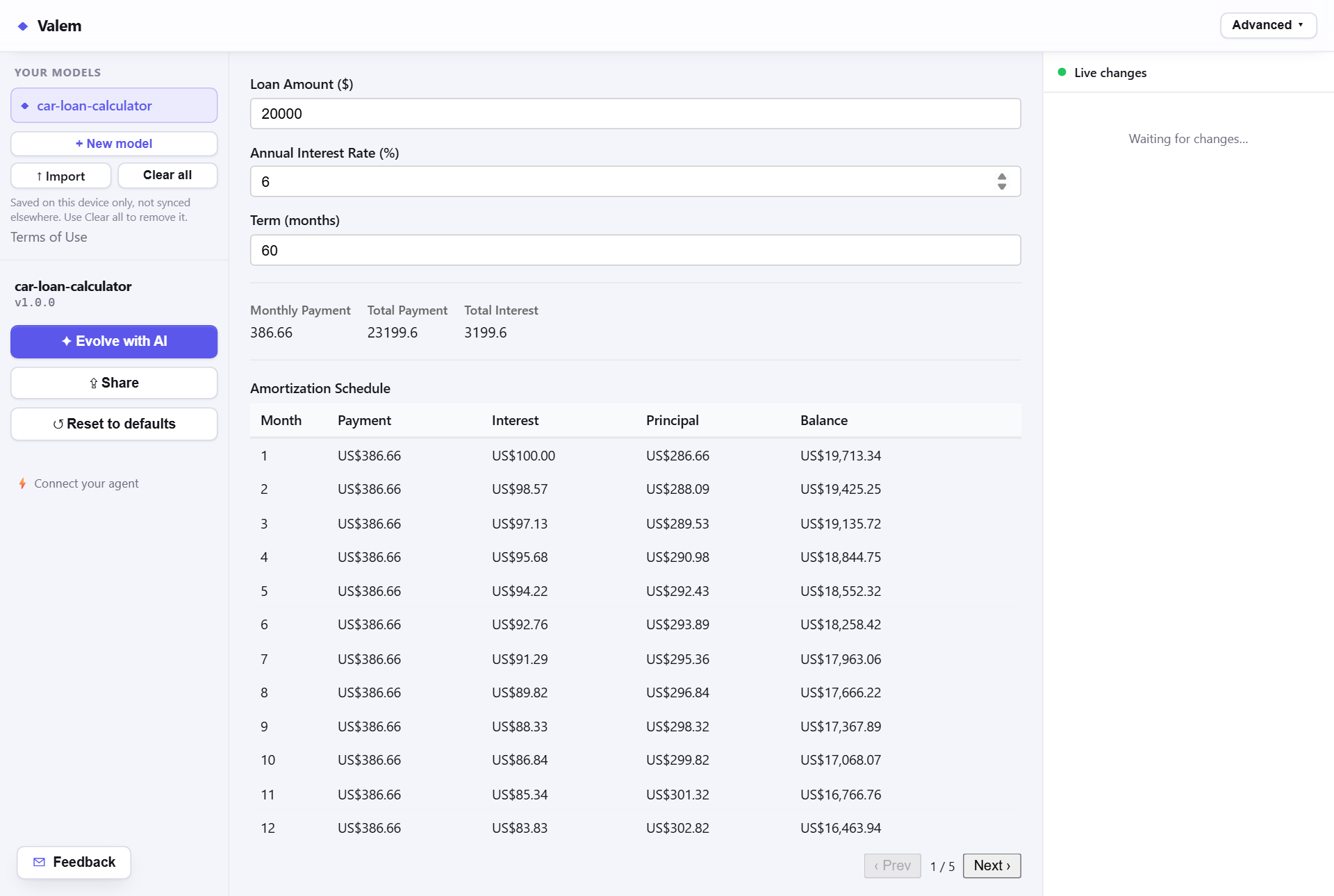
A zero-setup public demo: describe a domain in plain language, watch an LLM generate a ModelSpec, then type into it and see derivations, constraints, and effects react live. Open the sandbox → · what to do in it
Why it exists
- Deterministic & replayable. The pure core performs no I/O; the same inputs always produce the same state, and history replays without re-contacting the outside world.
- Reactive by construction. A dependency graph recomputes only what a change actually affects.
- LLM-native. Specs are JSON an LLM can generate, and Valem validates-and-repairs them in a loop.
- Effectful, but governed. Effects (HTTP, LLM calls, timers) are declared in the spec, executed post-commit behind an egress guard, and fold back into state as ordinary mutations — replay never re-runs I/O.
- Explainable. Every derivation and constraint evaluation is traceable, with an optional durable, tamper-evident audit trail.
- Embeddable. A pure-Java core with no framework lock-in, wrapped by an à-la-carte Spring layer.
Not sure it fits your problem? Usage scenarios covers the four shapes it fits best, and the FAQ is blunt about when to use something else.
The documentation, in six chapters
| Chapter | Start here if you want to… |
|---|---|
| Getting started | See it work, run it locally, or pair it with an AI agent. |
| Usage scenarios | Decide whether it fits your project. |
| Model guide | Write and understand a model. |
| Reference | Look up a field, endpoint, tool, or component. |
| Deployment | Run the API or the MCP server for real. |
| Extending | Embed the engine or build on its seams. |
Plus a glossary, the FAQ, and the third-party libraries Valem stands on.
Requirements: Java 21+ · Maven 3.9+ · Node.js 20+ (for the UI only) — or Docker, which needs none of them. Apache-2.0. Latest release: v1.0.0.
See also
- Valem sandbox
- Valem source code
- tracked-json — Jackson JsonNode wrapper that tracks each node’s location (JsonPointer) and document root through every navigation — get, path, at, parent(), and JSONPath (RFC 9535). Includes JSON Patch (RFC 6902).
- jsonata-jvm-compiler — A Java library that compiles JSONata expressions into native Java classes at runtime